22 Jun 2026 • 5m read
How to Adjust Motorcycle Suspension

Learning how to adjust motorcycle suspension can have a transformative impact on your riding experience. When you first buy a motorcycle, the suspension is usually set up to suit the average rider, which often means it won’t match your weight or riding style particularly well.
Understanding how to adjust suspension yourself is one of the key lessons for a new owner, much like learning how to replace motorcycle batteries or getting comfortable riding in different weather conditions.
Once you tailor the suspension to suit your own weight, the difference is immediate: smoother rides, more consistent tyre contact with the road, increased comfort over bumps, and improved braking response. In this guide, we explain how to adjust motorcycle suspension properly and highlight some of the most common mistakes to avoid.
Why Motorcycle Suspension Adjustment Matters
A motorcycle's suspension has a number of important jobs to perform. It must support the weight of the bike and the rider and must also keep the tyres in contact with the road or the surface being ridden on. At the same time, the suspension needs to absorb shocks and vibrations, providing a smooth riding experience, even on difficult terrain.
Suspension has a major impact on traction, control, stability and brake performance. If the suspension is too stiff, it will feel harsh going over bumps and can cause the tyres to skip over uneven surfaces. If the suspension is too soft, it can make the bike feel unstable to ride and can cause excessive fork dive under heavy braking, where the bike feels like it's falling forward. This can impact your confidence and enjoyment as a rider.
In other words, by adjusting your motorcycle suspension, you're optimising the way the bike supports your weight and the amount of time the tyres spend in contact with the road, while minimising discomfort and instability.

Key Suspension Terms Riders Should Know
Before you get to work on adjusting your motorcycle suspension, it's important to get to grips with some key suspension-related terms. This will enable you to understand instructions and can also provide you with a more rounded knowledge of your bike and how suspension actually works to deliver a smooth ride.
Common suspension terminology
Below, you can find a breakdown of some of the most common motorcycle suspension terms.
Fork
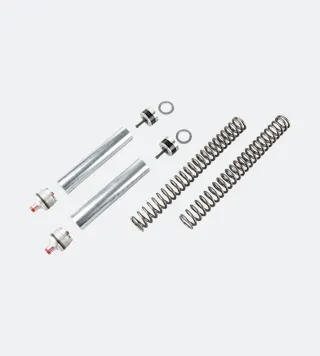
The fork is the suspension system at the front of the motorcycle. It supports the front wheel, absorbs bumps, and helps keep the tyre in contact with the road under braking and cornering. Most forks contain two springs and a damping system, working together to control movement and stability.
Shock
The shock absorber handles suspension duties at the rear of the bike. It manages bumps, acceleration forces, and rider weight through a single spring and damping system. The rear shock plays a major role in how stable the bike feels when exiting corners or riding over uneven surfaces.
Travel
Travel refers to how far the suspension can move between its fully extended and fully compressed positions. Motorcycles have separate measurements for front fork travel and rear shock travel. More travel can help with rough roads or off-road riding, while less travel usually supports sharper road handling.
Sag
Sag is the amount the suspension compresses under weight before the bike is moving. Static sag measures compression under the motorcycle’s own weight, while rider sag measures compression with the rider seated. Correct sag helps the suspension work within its intended range.
Preload
Preload describes the initial tension applied to the suspension spring before any weight is added. Adjusting preload does not change spring stiffness, but it does change how much the suspension compresses under load. Increasing preload reduces sag, while reducing preload allows the suspension to sit lower.
Compression
Compression is the movement of the suspension as it shortens to absorb bumps or impacts. Compression damping controls how quickly this movement happens. Too little damping can cause the suspension to collapse too fast, while too much can make the ride feel harsh.
Rebound
Rebound is the suspension extending back to its normal position after being compressed. Rebound damping controls the speed of this return. Proper rebound helps prevent the bike from bouncing or feeling unsettled after hitting a bump.
Ride height
Ride height refers to how high the motorcycle sits relative to the ground. It is influenced by preload settings, suspension length, wheel size and tyre profile. Changes to ride height can affect steering speed and stability, as well as overall balance.
Spring rate
Spring rate measures how stiff a suspension spring is and how much force is needed to compress it. A higher spring rate means a stiffer spring, while a lower spring rate means a softer one. Choosing the correct spring rate helps the suspension support the rider properly without excessive sag or harshness.




How to Set Your Motorcycle's Sag
Before making any suspension adjustments, it’s worth understanding motorcycle sag. Much like learning how to change your motorcycle oil starts with understanding what the oil does, setting up your suspension begins with knowing how sag works. Sag is one of the most important parts of a suspension setup, influencing comfort, grip, braking performance and overall stability.
Sag measures how much the motorcycle’s suspension compresses under weight. Static sag refers to compression under the weight of the bike alone. Rider sag measures compression with the rider seated on the bike in full riding gear. This measurement is also taken separately at each end of the motorcycle. Front sag refers to the suspension at the front of the bike, while rear sag refers to the suspension at the back.
Measuring your current sag
The first thing you'll want to do is measure your current sag. This is easier if you have a second person to assist you.
Step 1: Have one person gently lift the front wheel of the bike off the ground slightly. Make sure it's not in contact with the ground. While elevated, measure from the front axle to a fixed point on the fork bridge. This will give you the measurement for your front suspension when it's fully extended.
Step 2: Next, do the same for the rear suspension. Lift the rear of the bike so the wheel is off the ground. Measure from the rear axle to a fixed point on the tail of the bike. This gives you your fully extended rear suspension measurement.
Step 3: If you don't have a second person to help you, you can elevate the bike using a paddock stand.
Step 4: Now, put the bike down and measure the exact same points on both the front and rear. Subtract these numbers from your fully extended numbers to get the difference. This gives you your static sag measurements.
Step 5: Sit on the bike in full riding gear, with your feet on the pegs, and measure the same points again. Subtract these numbers from your fully extended measurements, and you'll have your rider sag figures.
Step 6: Finally, you need to measure total suspension travel. Press down firmly on the front suspension as far as it will reasonably go. Measure the same points as before at the front, then repeat the process at the rear. Subtract these measurements from the fully extended measurements. This gives you your total suspension travel.
To set the sag, you're going to need to adjust the preload, which we'll cover in the next section.
Recommended sag settings for general road use
For general road usage, set your front and rear as follows:
Front suspension (forks)
Static sag: Around 5% to 10% of total suspension travel
Rider sag: Around 25% to 30% of total suspension travel
Rear suspension (shock)
Static sag: Around 5% to 10% of total suspension travel
Rider sag: Around 30% to 35% (around one third of total travel)
How to Adjust Preload
As mentioned, preload is the primary way suspension sag is adjusted, making it one of the most critical techniques to learn. By either increasing or decreasing preload, you can alter the amount the suspension compresses under the weight of the bike alone (static sag) and while you are riding it in full riding gear (rider sag).
There are two crucial things to remember. Firstly, increasing preload decreases sag, while decreasing preload increases sag. Secondly, preload does not alter suspension stiffness — it adjusts where the suspension sits when weight is applied, either from the bike alone, or from the bike and the rider combined.
A broad aim when adjusting the preload, at least for most people, is to get your front and rear sag figures into the ranges outlined in the previous section. However, if you're going to be racing your bike, you may want to reduce sag from these figures in order to deliver more precise handling, especially at high speeds.
Once you know whether you're aiming to increase preload to decrease sag, or decrease preload to increase sag, you can get to work on actually making the necessary adjustments.
For the rear shock, this usually requires a C-spanner, but the specific tool can vary depending on your motorcycle model. The adjuster itself is often on the shock body, near the spring, and may look like a notched collar.
The preload adjusters for the front fork are usually at the top of each fork leg. They may look like hexagonal nuts or marked screws. You'll usually need a hex key, socket or screwdriver to make these adjustments.
In both cases, the usual rule of thumb is as follows:
Turning clockwise: Adds more preload
Turning anti-clockwise: Reduces preload
You'll need to make sure you adjust both fork legs by the same amount for a balanced outcome.
After you make the adjustment, re-measure your static and rider sag and then make further micro-adjustments, if necessary, so you get your motorcycle's suspension into the range you're aiming for.

How to Adjust Rebound Damping
Rebound damping controls the speed at which the suspension returns to its normal position after being compressed by hard braking or hitting a road bump. If rebound damping is too light, your motorcycle will feel bouncy. If it's too heavy, it may not always return to its natural position in time for the next bump in the road.
In general, you're aiming for a rebound that returns the bike from its fully compressed position in around one to two seconds. More importantly, you want the suspension to rise back up once, smoothly, without bouncing. You don't want the suspension to snap back up instantly, nor do you want it to take too long to return to its natural position.
For the front suspension, the rebound adjuster is usually found at the top of the fork, close to the preload adjusters. Occasionally, there may be an adjuster for each fork leg. For the rear suspension, the adjuster is usually located at the bottom of the shock. Rebound adjusters are often small, coloured knobs, but can also be small screws. They're smaller than preload adjusters and will require more precise adjustments, using less force.
Turning the adjusters clockwise will increase rebound damping, resulting in a slower return to the bike's natural position. Turning anti-clockwise will decrease rebound damping, resulting in a snappier return.
You can easily make small adjustments, one click at a time, until the rebound damping is where you want it to be.
How to Adjust Compression Damping
Compression damping on your bike controls how quickly the suspension compresses when it encounters a force. If it's too soft, it'll bottom out when going over bumps, and if it's too firm, it will lead to an uncomfortable ride. Therefore, you want to set compression damping to find the ideal middle ground.
The adjusters for compression damping often look very similar to rebound adjusters, but they're usually positioned away from them. You may need to consult your manufacturer's handbook, but the most common setup is for the front compression adjuster(s) to be at the bottom of the fork legs, with the rear adjuster at the top of the shock.
Again, you'll only make small adjustments, and it's best to approach this one click at a time.
Suspension Setup for Different Riding Conditions
There are certain principles you'll want to apply when riding in different conditions.
If you're going to be riding with a pillion, your bike will need to support more weight than normal. Broadly, the aim is to increase preload to reduce sag, especially at the rear of the bike. The front suspension may also need to be adjusted, but this will be a smaller change, as the rear is bearing most of the extra weight.
The same basic principle also applies when travelling with a passenger or carrying a large amount of luggage on the back of your motorcycle. In both cases, you may also need to make a slight increase to rebound damping, too, but this is usually less important, especially for one-off rides.
For racing purposes, it's usually recommended to reduce sag from where it would be on a conventional road bike. Firmer settings can also help you to achieve a greater sense of control. By contrast, when riding your bike on roads, prioritise slightly softer settings to maximise comfort when travelling over bumps and potholes.

Common Suspension Mistakes to Avoid
Much like learning how to clean your motorcycle chain or work on a carburettor, adjusting suspension comes with a few common pitfalls. Being aware of these mistakes will help you avoid unnecessary frustration and get better results from your setup.
One of the most common errors is confusing preload with damping. Preload is used to set static and rider sag, while damping controls how quickly the suspension compresses and rebounds. Adjusting the wrong setting can easily make the bike feel worse rather than better.
Making changes to only the front or only the rear suspension is another common error and one that can upset the entire balance of the bike. Similarly, when you change the preload at the front of the bike, you need to avoid asymmetry in the way you make adjustments. Make sure you turn the adjusters the same amount on both sides of the fork.
Unless you have a good reason to do so, avoid making major changes to the suspension all at once. It's much better to make small, incremental changes and continually test the sag, rebound and compression.
It's also critical to read the manufacturer's guidelines. Every bike is different, and a key part of learning how to adjust motorcycle suspension involves learning some of the differences between models.
When to Consider Professional Suspension Tuning
Learning how to adjust motorcycle suspension yourself is invaluable, but going it alone isn't always the best approach.
You may want to consider professional suspension tuning if:
You're not feeling confident about adjusting your bike's suspension yourself.
You don't have a second person to assist you.
You've adjusted the motorcycle suspension, but aren't happy with the results.
You're a professional rider trying to tune your suspension for a race.
You should also speak to a professional if you are experiencing issues that are indicative of a problem with your suspension system, like fluid leaks or sudden changes to how it feels to ride over bumps.
A specialist will have access to more advanced tools and will be able to make more technical changes, based on your specific needs. For example, if you're unable to get your motorcycle suspension settings right by adjusting preload and damping, it could also be a sign that you need to alter the spring rate. This is usually a job for a professional with the right tools, and it can even be dangerous to attempt on your own, as the springs on a motorcycle are under high tension.
Getting Your Suspension Set Up Right
Adjusting your motorcycle suspension doesn’t need to be complicated. By setting sag first, then fine-tuning preload, rebound and compression in small steps, you can make noticeable improvements to comfort and confidence on the road. Take your time, make one change at a time, and don’t hesitate to seek professional help if the bike still doesn’t feel right.

Frequently Asked Questions About Motorcycle Suspension
If you’re still unsure how to adjust motorcycle suspension, the answers below cover the questions riders ask most often.